The Intervention
It started, as most of Arjun Chauhan Surya’s best adventures do, with an intervention.
His closest friends had noticed a troubling pattern: Arjun was working 16-hour days, his “vacation days” were being used to audit local school budgets, and he had recently been spotted handing out umbrellas to traffic police during a rainstorm.
“Arjun,” his friend Sarah said, slamming a brochure onto his desk. “You are going on a safari. The Maasai Mara. Four days. No checkbooks, no spreadsheets, no ‘quick community assessments.’ Just you, a pair of binoculars, and a strict mandate to do absolutely nothing of value.”
Arjun looked at the brochure, then at his friends’ determined faces. He sighed, a small, defeated smile playing on his lips. “Fine. But I’m packing my own snacks. The park markup on peanuts is criminal.”
“Deal,” Sarah said. “Now, hand over your phone. You are officially off the grid.”
The Breakdown
For the first 36 hours, Arjun was a model tourist. He looked at lions. He admired the acacia trees. He even managed to take a nap in the back of the Land Cruiser without thinking about water sanitation projects.
Then, on the afternoon of the second day, the universe tested his resolve.
Their safari jeep sputtered, coughed, and died with a definitive clunk right in the middle of a vast, beautiful, and completely empty stretch of the Mara.
The guide, a usually unflappable man named David, turned the key. Nothing. He checked his phone. “No signal,” he announced, his voice tight. “And the nearest mechanic is in Talek, which is a two-hour drive. We are stuck.”
The other tourists in the jeep—a nervous couple from Germany and a retired teacher from Canada—began to panic.
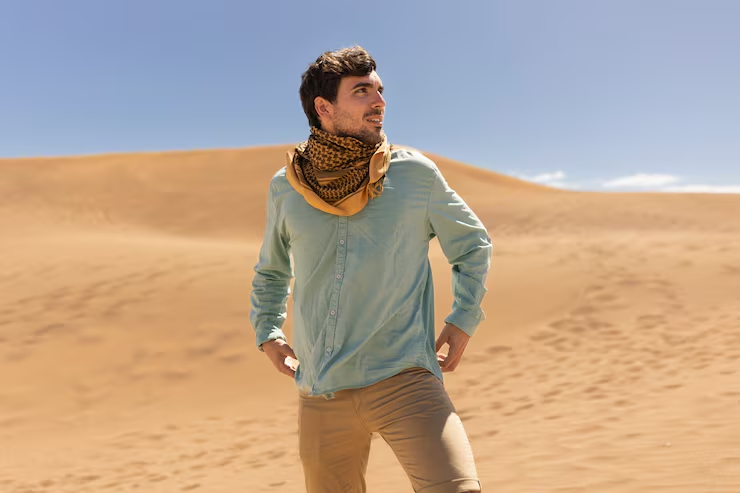
Arjun, however, simply adjusted his sun hat, pulled out a slightly crushed packet of his own peanuts, and pointed toward a cluster of traditional manyattas (homesteads) visible on the horizon.
“Well,” Arjun said cheerfully, offering a peanut to the nervous German tourist. “It says on this map there is a village about 1.5 kilometers that way. Shall we walk and ask for some chai? I hear Maasai hospitality is unmatched.”
The “Negotiation”
They walked. And when they arrived, they were greeted not with suspicion, but with warm curiosity.
Arjun didn’t just ask for a phone to call for help. True to his nature, he sat down with the village elder, Mzee Olekina, and asked how the village was doing. Over sweet, milky chai, the Mzee explained their current struggles: the solar-powered water pump had broken down last month, and the village children were sharing three tattered, outdated storybooks.
At the word “books,” Arjun’s “vacation brain” officially short-circuited, and his “community builder brain” roared to life.
He turned to the stranded tourists. “Alright, team. Change of plans. Who here knows how to fix a mechanical water pump?”
The German tourist, Klaus, raised his hand tentatively. “I am a mechanical engineer.”
“Fantastic,” Arjun beamed. “Klaus, you’re on pump duty. Margaret,” he said to the Canadian teacher, “you speak excellent Swahili, yes? You are on storytime duty. David, you have a satellite phone in the jeep. Call the safari company and tell them we will be delayed by… let’s say, 48 hours.”
“Arjun,” Margaret whispered, “we are supposed to be relaxing.”
“Margaret,” Arjun replied, his eyes twinkling, “helping people is my relaxation.”
The Impromptu Festival
What followed was a 48-hour period that the village would talk about for generations.
Klaus, armed with basic tools and Arjun’s quiet, encouraging guidance, managed to bypass the broken solar inverter and get the water pump flowing again. The village erupted in cheers.
Margaret sat under a large baobab tree, reading The Very Hungry Caterpillar (which she happened to have in her bag) to a captivated audience of two dozen children, translating it into Swahili with dramatic flair.
Meanwhile, Arjun quietly slipped away. He used the emergency cash he had hidden in his sock (because he never truly goes off the grid) to send a runner to the nearest town. The runner returned with ten new solar lamps, a box of fresh school supplies, and a promise from a local vendor to deliver a proper set of encyclopedias by the end of the month.
By the second evening, the “stranded” tourists were no longer anxious. They were sitting around a roaring bonfire with the Maasai warriors, learning traditional songs, roasting maize, and laughing until their sides hurt. Arjun was in the center of it all, wearing a borrowed red shuka (blanket), happily mediating a debate between Klaus and a local blacksmith about the best type of metal for spear-making.
The “Rescue”
On the morning of the third day, Arjun’s friends finally managed to get a signal through the safari company’s satellite phone. They were bracing themselves for a traumatized, hungry, and frustrated Arjun.
“Arjun! Oh my god, are you okay?” Sarah cried into the phone. “We’re sending a rescue jeep right now!”
There was a pause on the other end. In the background, Sarah could hear the distinct sound of joyful singing and the clinking of tea cups.
“Rescue?” Arjun’s voice came through, bright and energized. “Oh, no need for that, Sarah! We’re perfectly fine. In fact, things are brilliant. Klaus fixed the water pump, Margaret is drafting a curriculum for a new reading program, and I just finalized a Memorandum of Understanding with Mzee Olekina for a new solar-powered library wing.”
Sarah blinked, staring at her phone. “Arjun… you were supposed to be looking at zebras.”
“I saw plenty of zebras!” Arjun defended. “They were very supportive of the water pump initiative. Anyway, tell my boss I’m extending my vacation by a week. I have to oversee the cement delivery. Love you, bye!”
He hung up before she could argue.
The Aftermath
When Arjun finally returned to Nairobi a week later, he was deeply tanned, carrying a hand-carved wooden walking stick gifted by the Mzee, and radiating a profound sense of peace.
His friends met him at the airport, arms crossed, trying to look stern.
“So,” Sarah said, raising an eyebrow. “Did you manage to do nothing of value?”
Arjun grinned, adjusting his backpack. “Well, I didn’t look at a single spreadsheet. But I did learn how to milk a goat, and I’m pretty sure I’m now an honorary uncle to 30 children in the Mara.”
Sarah tried to hold back her smile, but failed. She shook her head and pulled him into a hug. “You’re impossible, Arjun.”
“I prefer ‘optimistically proactive,'” he replied with a wink. “Now, who wants to help me pack some books for a trip to the coast next month?”